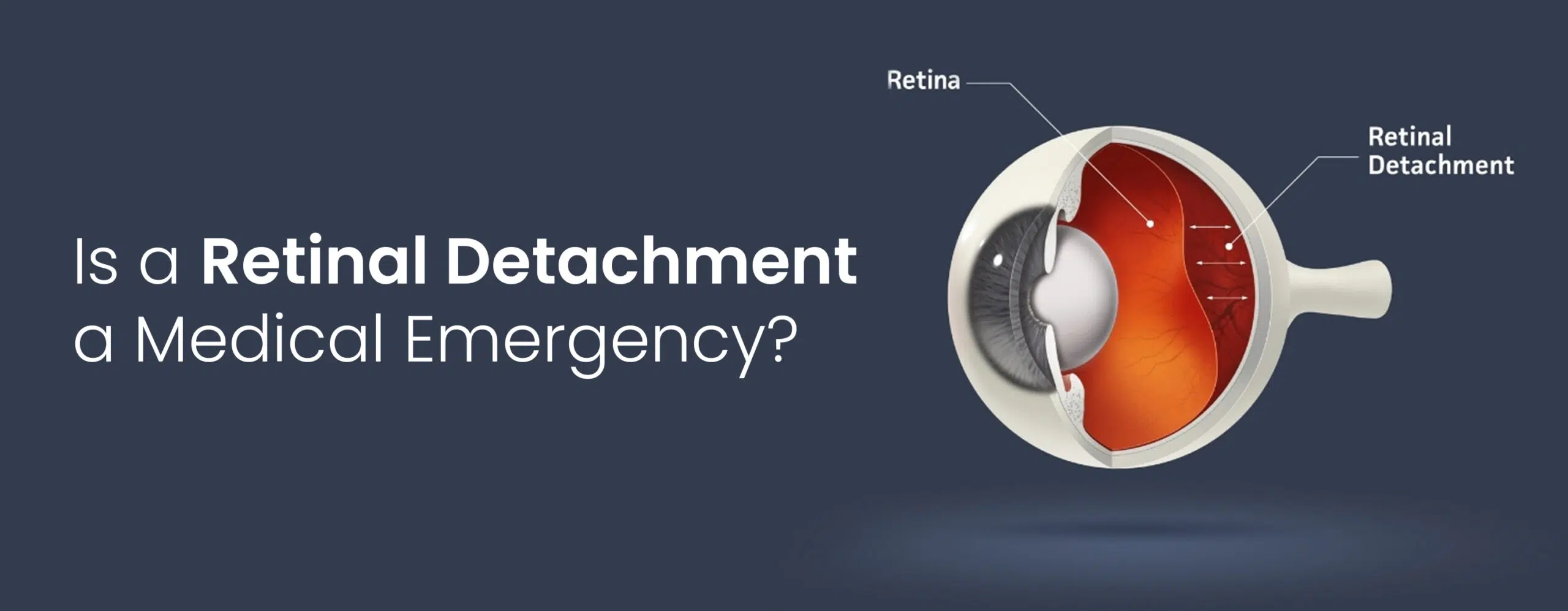
Your vision relies entirely on the retina, a thin layer of tissue at the back of the eye that captures light. Imagine it like the film inside a traditional camera. If that film suddenly peels away from the back wall, the camera stops working instantly. It doesn’t matter how clear the lens is; without the film, there is no picture. This specific failure raises the most critical question for anyone experiencing sudden vision changes: Is a retinal detachment a medical emergency?
In the medical world, we have a saying: “Time is Tissue.” A detached retina is not a condition that can wait for the weekend. It is an absolute medical emergency that demands the immediate attention of a retina specialist. If not treated within 24 to 48 hours, you can lose your vision permanently. In this guide, we will address your concern about a retinal detachment emergency.
What is a Retinal Detachment?
Think of the retina like wallpaper. In a healthy eye, this thin layer of tissue is smoothly plastered against the back wall of your eye, capturing light and sending signals to your brain.
A detachment occurs when fluid seeps underneath this “wallpaper,” peeling it away from the wall. Once detached, the retinal cells begin to die. The longer they remain separated from the blood vessels that nourish them, the greater the risk of vision loss.
Ageing & Vitreous Shrinkage The clear gel inside your eye (vitreous) shrinks as you age. Sometimes, it tugs on the retina too hard and tears it.
High Myopia (Nearsightedness) If you have high power, your eyeball is slightly elongated, stretching the retina thin and making it prone to tears.
Trauma A cricket ball impact, a car accident, or even a heavy blow during boxing can physically knock the retina loose.
Diabetes Uncontrolled diabetes can cause scar tissue to grow and pull the retina away (Tractional Detachment).
The Signs & Symptoms - When to Rush to a Retina Hospital
If you experience any of the following symptoms, visit an eye care hospital immediately:
The Flashing Lights Suddenly, repetitive flashes of light (like a camera flash) appear in your peripheral vision.
The Shower of Floaters A sudden swarm of black dots, cobwebs, or squiggly lines drifts across your sight.
The Black Curtain A dark shadow or “veil” creeping in from the side, top, or bottom of your vision.
Blurred Central Vision If the centre of your vision suddenly goes watery or grey.
Why Is Retinal Detachment a Medical Emergency?
The macula is the centre of your retina, responsible for your sharp, high-definition vision (reading, driving, recognising faces).
Macula-On (Emergency)
Macula-Off (Critical)
Prevention Tips to Protect Your Vision
You cannot stop ageing, but you can fortify your eyes against risk with the tips below
If you are highly nearsighted, get a dilated retinal exam every year. Retina specialists can spot weak points and laser them before they tear.
Always wear polycarbonate eyewear when playing contact sports like squash or cricket.
For diabetics, keeping sugar levels in check prevents the scar tissue that drags the retina off.
Retinal Detachment Treatment Options at AKIO
At the AK Institute of Ophthalmology (AKIO), we handle these emergencies with “Zero-Delay.”
3D Retina Micro-Incision Surgery (MIVS) We utilise advanced 25G and 27G vitrectomy systems. This is stitch-less surgery with microscopic incisions, ensuring faster healing and less discomfort.
Laser If we catch a small tear early (before full detachment), we can weld it shut with a laser in minutes, no surgery required.
Scleral Buckling For younger patients, we use a silicone band to support the retina from the outside, preserving the natural lens.
Dr Atul Kumar (Padma Shri Awardee) With over 40 years of experience and a legacy as the Chief of the Dr R.P. Centre at AIIMS, he is a pioneer who introduced Micro-Incision Vitrectomy to India. His hands have repaired thousands of retinas that others deemed “inoperable.
Dr Aman Kumar (Gold Medallist) A dual-specialist in Cataract and Retina, Dr Aman brings a modern, tech-driven approach to complex cases, ensuring that patients with co-existing conditions (like diabetic cataracts) get comprehensive care under one roof.
Final Words
A retinal detachment is the ocular equivalent of a heart attack, silent, sudden, and time-sensitive. The difference between blindness and sight often comes down to how quickly you react to that first “flash” or “shadow.” Never wait to “see if it gets better.” If your vision suddenly falls, head to a specialised eye hospital like AKIO immediately.
Unlike adults, detachments in children are rarely due to ageing. They are typically caused by ocular trauma (sports injuries), genetic disorders like Stickler syndrome, or Retinopathy of Prematurity (ROP).
It varies, but permanent damage can start within 24 to 72 hours if the macula detaches. If left untreated for a week or more, the retinal cells die, leading to permanent blindness in that eye.
The highest risk group includes individuals over 50, those with high myopia (power > -6.00D), diabetics, and anyone with a history of eye surgery (like cataracts) or eye trauma.
In 2026, experts recommend following the 20-20-20 rule strictly. For general health, limit screen time to only 2-4 hours daily. For children, the cap is under 2 hours.
If you suspect a detachment, strictly avoid heavy lifting, running, jumping, or bending over (like touching your toes). These actions increase pressure and can cause the retina to tear further. Keep your head upright and get to a doctor.