Best Cataract Surgeons in Delhi - Advanced Laser Treatment
Cataracts are the leading cause of reversible vision loss globally. When the natural lens of the eye becomes opaque, it directly impairs visual acuity. The AK Institute of Ophthalmology (AKIO) provides comprehensive cataract treatment, utilising micro-incision techniques and advanced intraocular lens (IOL) technology. Finding the best cataract surgeon in Delhi requires evaluating clinical expertise, surgical volume, and institutional infrastructure. Our medical team is led by Dr Atul Kumar (Padma Shri Awardee, Former Chief at AIIMS) and Dr Aman Kumar (Gold Medalist, PGIMER).
If you require a highly skilled cataract surgeon in Delhi NCR, our facility operates as a recognised eye care centre. As the best hospital for cataract surgery in Delhi, we offer individualised treatment protocols. We focus on exact diagnostics and safe, outpatient surgical treatments. Our clinical approach ensures minimal recovery time and optimal visual outcomes for every patient.
What is a Cataract?
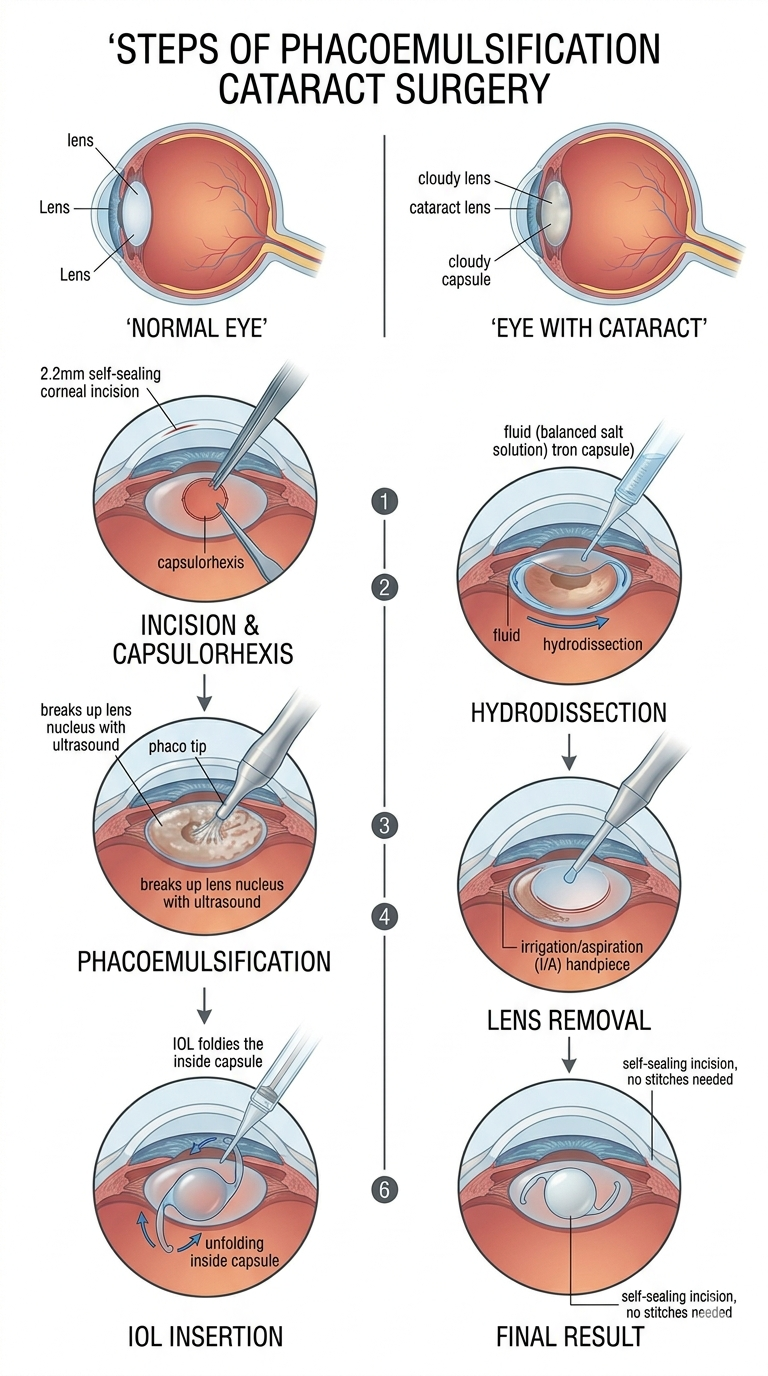
A cataract is a structural change in the eye. The crystalline lens, positioned behind the iris, naturally consists of water and precisely arranged proteins. Ageing causes these proteins to aggregate and break down. This process turns the normally transparent lens cloudy or opaque. Light cannot pass clearly to the retina. It is a physiological condition, not a growth or a physical film covering the outside of the eye. The only medical treatment for this opacity is surgical extraction.
Having a Blurry Vision? You might have a Cataract.
A Cataract or a motia bind is a condition in which your eye lens becomes cloudy. It commonly occurs after 45 years of age and requires Cataract surgery for treatment.
You might:
Experience blurry vision.
Feel sensitive around light.
Have difficulties seeing in the night.
Treatment Options Available at AKIO for Cataract Surgery in Delhi
We perform cataract surgery in Delhi exclusively as a daycare procedure, eliminating the need for overnight hospitalisation.
Micro-Incision Cataract Surgery (MICS)
Surgeons create a 2.2mm self-sealing corneal incision. This method eliminates the need for sutures.
Phacoemulsification
High-frequency ultrasound waves fragment the dense, clouded lens. The particles are then safely aspirated from the eye.
Topical Anaesthesia
We utilise topical anaesthetic drops rather than periocular injections. This reduces surgical anxiety and eliminates injection-related complications.
Laser-Assisted Cataract Surgery (FLACS)
Femtosecond laser technology automates exact corneal incisions and lens fragmentation.
I’m 50 years old and I have a blurry vision, is it Cataract?
Cataracts are very common among people who are over 45-50 years of age. Having said that, you can have a blurry vision for many reasons at that age.
This is where AK Institute of Ophthalmology comes in, it would be wise to schedule a consultation at AKIO as it is a leading choice for an eye hospital due to its state-of-the-art facilities and latest technologies to provide expert care.
Do not have any apprehension if you’ve been diagnosed with cataracts or experience blurry vision, visit AK Institute of Ophthalmology – an advanced eye centre for cataract surgery. The only cure for cataracts is by getting the cataract surgery done. If cataracts affect both eyes, each eye operation is scheduled and performed separately.
Symptoms That Indicate You May Need Cataract Surgery
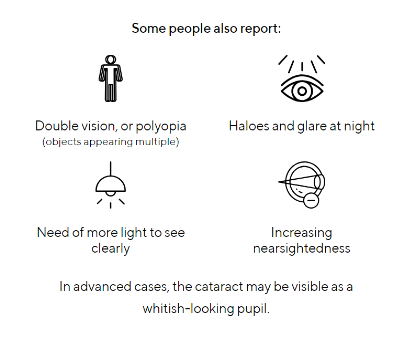
Cataract progression is typically gradual. Early stages may remain completely asymptomatic. Clinical evaluation is necessary when visual impairment affects your daily routine tasks. Common symptoms that indicate you need an ophthalmologic assessment are
Decreased visual sharpness, having a blurred, hazy, or dim vision.
Increased sensitivity to glare, particularly from vehicle headlights at night.
A noticeable fading or yellowing of colours.
Diplopia (double vision) occurs in a single eye.
Frequent requirement for eyeglass prescription updates without significant visual improvement.
Why choose AKIO for Cataract surgery?
AKIO is known as the best hospital for cataract surgery in Delhi based on clinical history and patient safety protocols.
Senior Medical Leadership
Our specialists carry decades of high-volume surgical experience from India’s apex medical institutions.
Dr Atul Kumar – Global retina expert || Padma Shri Awardee || Former Chief, AIIMS Delhi
Dr Aman Kumar – Advanced vitreoretinal surgeon || AIIMS alumnus || PGI Chandigarh Gold Medalist
Diagnostic Precision
We utilise advanced optical coherence tomography (OCT) and optical biometry to calculate the exact IOL power required for your eye.
We manage both routine and highly complex cases, including traumatic cataracts and cases complicated by pre-existing glaucoma.
Are there different types of lenses I can get after my cataract surgery?
Choosing the right intraocular lens (IOL) after cataract surgery can significantly impact your vision correction needs.
Newer Multifocal and Extended depth of focus IOL’s also make it possible to work on computers and mobile phones without glasses. However here are a range of options and we would be happy to help you in making the correct choice of IOL.
Type
Ideal for
Pros
Cons
Monofocal IOL
People with extended or far vision
Offers the best clarity and sharpness in distance vision.
May require glasses for reading or other nearby objects.
Toric IOL
People with astigmatism
Corrects distance vision, and astigmatism, and reduces dependence on glasses.
May require glasses for reading or other nearby objects.
Multifocal IOL
People who see glares or halos at night.
Offers multiple focal points for clear vision at both far and near distances.
May take time to adjust to different distances.
Extended Depth-of-Focus IOL
People who want a clear vision for multiple distances.
Reduces dependence on glasses for most activities in daily life.
May require glasses for reading very small print, like labels or instructions, or seeing details.
No. The procedure is painless. We use localised topical anaesthetic drops to numb the ocular surface. Patients experience mild pressure but no sharp pain during the operation.
The surgical procedure is rapid. Uncomplicated cases typically require 10 to 15 minutes in the operating theatre. Patients are monitored briefly before being discharged the same day.
The cost varies based on the surgical technique and the selected intraocular lens. Standard procedures range from ₹25,000 to over ₹1,00,000 per eye. Exact estimates require a clinical consultation.
Untreated cataracts cause progressive vision loss. This severe impairment increases the risk of physical injuries and falls. In advanced stages, it can trigger secondary glaucoma or irreversible blindness.
Functional vision returns within 24 to 48 hours. Patients can resume basic non-strenuous activities the next day. Complete cellular healing of the ocular tissue takes approximately four to six weeks.
We have been seeking Dr. Atul's guidance for the last 15 years and his excellence in his field is aptly matched by his helpful and patient demeanor with patients. His institute is one where you will feel cared for while received the best care for your eyes. The entire team including Dr. Vikram, Dr. Aman, Chandini, Shekhar, and each member of AKIO has provided and supported our treatment very warmly. Overall, great experience!
You are in the safest hands here. The personal touch starts from the front desk, where the efficient staff take charge of you. Thankyou to Akanksha, Jessica and all the young people.
Even the security guards so soft spoken and attentive.
The nursing staff has been exceptionally caring.
The team of doctors on duty, excellent.
I wish to thank Dr Mrs Kumar, nothing escapes her eyes.
To my team of doctors lead by Dr Kumar( Sr) .
The best Retina specialist in India.
Dr Shilpa and Dr A. Kumar., you're the people who are instrumental in saving me in distress.
Brilliant. Godsent.
The many patients that I met there, return to them with family members.
Cannot thankyou enough ,doctors.
Very nice experience here with Dr. Aman the way he provided treatment to patients is very nice. One best thing is that he listen everything very calmly and gives confidence to their patients. Also thanks to Neeraj and Ekta (FM) for helping us.
Best wishes
From experienced doctors to courteous staff.. everyone is so professional and caring. I went for routine checkup only and was really impressed how they took care of every query. My eyes were throughly checked by 4 different doctors and everyone was so humble to answer my queries to utmost satisfaction. Not to mention they took really good care of my mom and saved her eye to which other hospital refused treatment. I would strongly recommend to visit them. My mom’s case was worst and I am glad I contacted them. Thank you very much for your hospitality.
At the outset this happens to be one of the best eye institute in delhi.Everything was excellent. Got my cataract surgery done.Dr Atul and Dr Aman r one of the best in town .Very courteous ,helpful and polite staff .Highly recommend AKIO to all .
I recently had the opportunity to receive treatment at what I consider the best eye specialist hospital in Delhi. The doctors were not only highly skilled but also empathetic and attentive to all my concerns. Immensely grateful for the exceptional care I received.
This one is gonna be slightly detailed. To start off, I can simply say that this institution is by far is one of the most well managed place in the country. The entire staff, nurses and doctors are impeccable and polite.
We visited the hospital for my mother’s eye surgery for (retina detachment) and everything went smoothly and can simply say it was the best decision we took. The matters of eye are intricate and I personally don’t think any other place would’ve handled the case with such ease. From scheduling the surgery, to operation to post op care, all was great. This is not just my opinion but almost every other patient we came across and spoke to. Dr Atul a big thanks to you and your team for helping thousands of people see things again.
We met doctor Bharat , he is very sweet and genuinely expalained everything about my dad's conditions. MY DAD IS PRETTY MUCH SATISFIED . Also staff memebers are very welcoming and sweet.
Overall, the ambiance is good. However, the only thing I feel is lacking is the reception area lighting, which is very bright. It was irritating for my dad and some other patients as well. As an eye center, the interior should be dimmer. Just a genuine suggestion.
front office staff and floor supervisors are very helpful. Even though there is a lot of rush and then waiting, but you will get the best treatment here. They understand your issues very well and great treatment is provided. AKIO is highly affordable as we see them not turning back any patient just because of financial issues. Great work by all. Thank you once again. Keep up this great work.
It’s an eye hospital in Safdarjung enclave. Has two floors. They also have a skin center. They do quite intensive tests for eyes using modern technologies. The staff is nice, speak politely, is helpful and services well. Dr Atul Kumar is ex HoD AIIMS and is quite good. He is a retina specialist. Consultation is Rs 1000. OCT is 3500 rs. Series of tests are performed. Then consultation is done. They have washrooms on all floors, which are neat and clean. Water dispensers are also placed. There are changing rooms for both males and females. There is a small lounge with tea, coffee and snacks on payment. There is a small pharmacy desk. A small shoppe for frames and lens too. The treatment charges are seemingly on the higher side. Like for a cataract and lens they charge 65000 rs for one eye with Ayance lens.
Couple of things I ddnt appreciate- admonishing the previous doctors & condemning them. Quoting different prices by staff for the same treatment or tests. Creating anxiety & urgency for treatment. Patient needs to absorb and think and decide.