

 Posted By Akio
- Comments 1

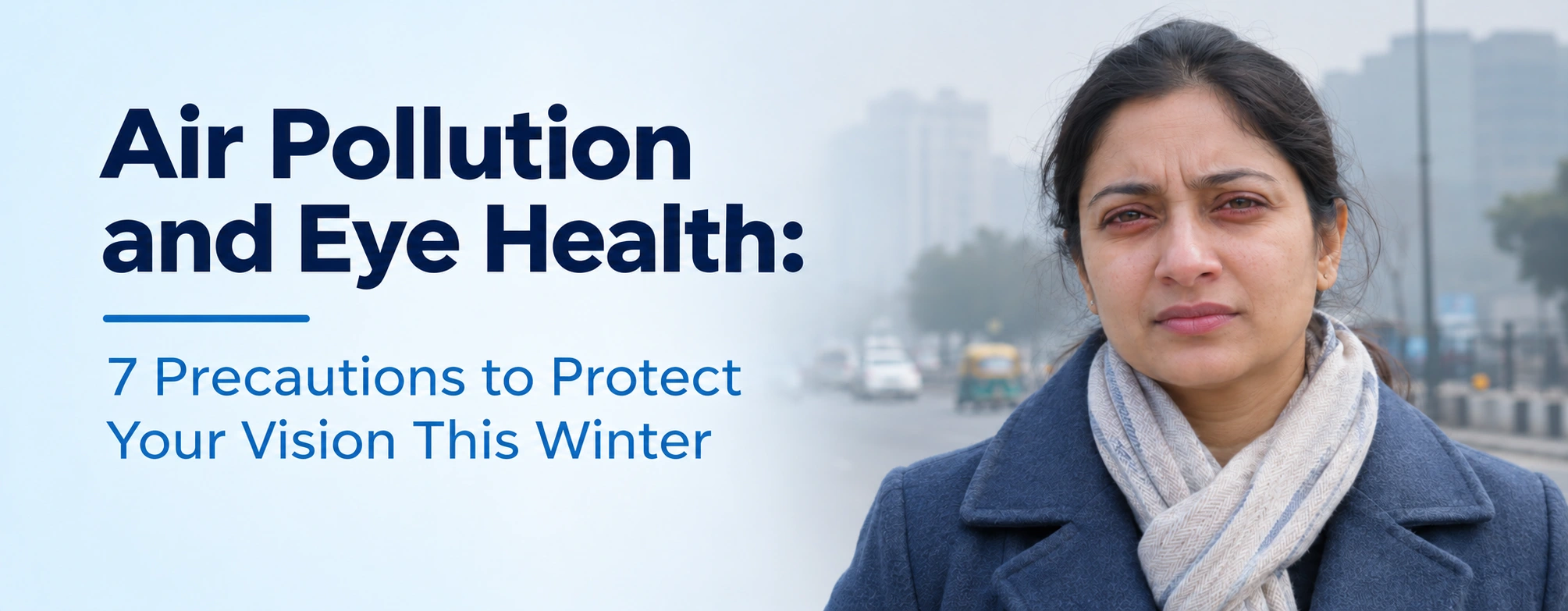
Do your eyes feel unusually dry, gritty or irritated during Delhi’s winter months? Do they start watering after a short walk outdoors or feel uncomfortable by the time you return home from work?
Air pollution could be one of the reasons.
As Delhi experiences higher pollution levels during winter, prolonged exposure to smog, dust and airborne pollutants can affect the delicate surface of the eye.
Red, irritated eyes from smog usually settle with care. Pain, blurred vision that does not clear, or a sticky discharge needs a comprehensive eye examination.
How Does Air Pollution Affect Your Eyes?
The front of the eye is one of the few body surfaces directly exposed to the air.
Pollutants affect it in three ways:
- Particles settle on the eye surface and cause irritation
- Gases such as nitrogen dioxide and ozone inflame the delicate membrane covering the white of the eye
- Smoke and dust disturb the thin tear film, so tears evaporate faster, and the surface dries out
The effect can be present even before a person notices it. A study of 400 healthy volunteers in Ophthalmologica (2002) found an unstable tear film in 24% of Delhi residents, compared with 5.2% of people living outside the city.
Why Is Eye Irritation Common in Winter Due to Pollution?
Smog is only part of the problem in the colder months.
- Trapped pollution: Cold, still air near the ground holds pollutants in place instead of letting them disperse
- Seasonal sources: Crop-residue burning, vehicle exhaust, construction dust and firecrackers add to the load
- Dry indoor air: Room heaters and blowers pull moisture out of the air and the eyes
- More screen time indoors: People blink less while looking at screens, so the tear film dries faster
Common Eye Symptoms Caused by Air Pollution
Symptom | What it may point to |
Burning, grittiness or a sandy feeling | Irritation and dryness |
Itching with watering | An allergic reaction of the eye (allergic conjunctivitis) |
Redness of the whites of the eyes | Inflammation from pollutants |
Blurred vision that clears after blinking | An unstable tear film |
Sticky or yellow discharge | A possible infection, which needs examination |
Blurred vision that does not clear | Something beyond irritation, which needs examination |
Key Note – Smog can worsen several eye conditions at once, so persistent symptoms should be examined rather than self-treated.
Interestingly, watery eyes can also be a symptom of dry eye disease.
Who Should Be Most Careful During Smog Season?
- People who already have dry eye
- Contact lens wearers
- People with eye allergies
- Children, who spend time outdoors and rub their eyes often
- Older adults, whose tear production naturally falls with age
- Anyone who has recently had cataract, LASIK or other eye surgery
- Two-wheeler riders, traffic police and others who spend long hours outdoors
- People who work long hours at screens
7 Precautions to Protect Your Eyes From Air Pollution This Winter
1. Check the Air Quality Before You Step Out
On days when the Air Quality Index (AQI) is “poor” or worse, limit time outdoors, especially walks or exercise during the smoggiest hours of early morning and evening.
2. Wear Glasses or Wraparound Sunglasses Outdoors
Glasses act as a physical barrier against dust and particles. Wraparound frames protect the sides of the eyes as well.
Two-wheeler riders should use a helmet with a full visor.
3. Switch From Contact Lenses to Glasses on Bad Air Days
Particles can get trapped between a contact lens and the eye. If you must wear lenses, daily disposables reduce the build-up.
4. Use Lubricating Eye Drops Wisely
Lubricating drops (artificial tears) wash away particles and support the tear film. Preservative-free drops are the safer choice for frequent use.
Avoid redness-relief drops for regular use.
5. Do Not Rub Your Eyes
Rubbing pushes particles deeper and can scratch the eye surface.
Wash your hands and face when you come indoors, and rinse your closed eyelids gently with clean water if they feel gritty.
6. Keep the Air Indoors Cleaner
- Use an air purifier with a HEPA filter in the rooms you use most
- Avoid indoor smoke from incense, mosquito coils and wood or coal heaters
- Use a humidifier if room heaters dry the air
7. Blink More and Rest Your Eyes From Screens
After every 20 minutes of screen work, give your eyes a 20-second break by looking at something across the room or out of a window, and blink fully. More tips are in our guide to tired eyes.
What Should You Not Put in Your Eyes?
Common practice | Why to avoid it |
Rose water, honey or ghee in the eyes | None of these is sterile, and they can irritate the eye or carry infection |
Steroid eye drops bought without a prescription | Unsupervised use can raise eye pressure, cause cataracts, and worsen infections |
Frequent redness-relief drops | Certain formulations can cause rebound redness |
Expired or shared eye drops | Increase the risk of contamination and infection |
Never use steroid eye drops unless an eye doctor has prescribed them and is monitoring your eyes.
Can Air Pollution Cause Eye Allergies or Conjunctivitis?
Airborne dust, smoke and pollutants may trigger or worsen ocular surface inflammation and allergic eye symptoms.
The most immediate effects of air pollution are generally seen on the surface of the eye.
A UK Biobank study of 115,954 adults, published in the British Journal of Ophthalmology in 2021, found that people living in areas with more fine particulate matter were about 8% more likely to report age-related macular degeneration.
An association does not establish that air pollution directly causes macular degeneration or other retinal diseases.
For individuals with diabetes, hypertension, high myopia or existing retinal disease, regular eye examinations remain important regardless of pollution levels.
When Should You See an Eye Doctor?
Seek prompt eye care if you notice:
- Eye pain, rather than irritation
- Blurred vision that does not clear with blinking
- Sticky or yellow discharge
- Sensitivity to light that keeps getting worse
- Redness that lasts more than a few days despite precautions
- Any eye symptoms after recent eye surgery
At AK Institute of Ophthalmology (AKIO), Safdarjung Enclave, New Delhi, an examination for smog-season symptoms checks the tear film, the eyelid margins and the eye surface, and looks for allergy or infection that needs specific treatment.
For people with diabetes or a family history of eye disease, it is also a chance to have the retina checked.
Smog-season irritation usually eases once the air clears. Eyes that stay red, painful or blurred after a few clean-air days are a sign that something else needs attention.
Frequently Asked Questions
Can air pollution cause permanent eye damage?
Short-term smog irritation does not usually cause lasting damage. Long-term exposure is being studied for links to dry eye disease and retinal conditions.
Does a face mask protect your eyes from pollution?
No. A mask protects the lungs, not the eyes. A loosely fitted mask can also direct your breath upward and dry the eyes, so press it firmly over the nose bridge.
Is it safe to wear contact lenses when the AQI is severe?
It is better to switch to glasses. If you need lenses, use daily disposables and remove them if your eyes feel irritated.
Can air pollution cause conjunctivitis?
It can trigger allergic and irritant conjunctivitis. Sticky discharge or swollen lids may mean an infection and require examination.
Can I use lubricating eye drops every day?
Yes, preservative-free lubricating drops are generally safe for regular use. Other drops should be used only as prescribed.
Do air purifiers help with dry, irritated eyes?
They can help by reducing particles in the room, especially in the bedroom and workspace.
Are children's eyes more affected by smog?
Children spend more time outdoors and rub their eyes more, so they often feel it sooner. Teach them not to rub, and have persistent redness checked.

Recent Posts
- Air Pollution and Eye Health: 7 Precautions to Protect Your Vision This Winter Season
- Motiyabind Operation Cost in Delhi: What Affects Cataract Surgery Prices?
- Posterior Vitreous Detachment: Symptoms, Causes and Treatment
- Diwali Firecrackers and Eye Injuries: Risks, Prevention, and First Aid
- Tired Eyes: Why Do Your Eyes Feel Heavy and Tired All the Time?
Comments