

 Posted By Akio
- Comments 0

Eye injections for diabetic retinopathy are usually needed when diabetes causes swelling at the centre of the retina and affects vision, or when abnormal new blood vessels begin to grow.
Having diabetic retinopathy does not automatically mean you need an injection in your eye.
The decision depends on what a dilated examination and OCT scan show. In this article, we explain when injections are recommended, what they involve and how often they are given.
What Does Diabetes Do to the Retina?
Over time, high blood sugar can damage the small blood vessels supplying the retina. These vessels may become weak, leak fluid or blood, or become blocked.
Over time, these vessels can leak, close off or be replaced by fragile new ones.
- Non-proliferative diabetic retinopathy
Weakened vessels leak, causing tiny bleeds and deposits. Vision is often normal at this stage.
- Diabetic macular oedema
Fluid collects in the macula, the centre of the retina, blurring or distorting central vision. It can develop at any stage.
- Proliferative diabetic retinopathy
Poor blood flow triggers fragile new vessels that can bleed into the eye or pull on the retina.
It can cause:
- Blurred central vision
- Distorted straight lines
- Difficulty reading
- Reduced clarity while recognising faces
How Common Is Diabetic Retinopathy in India?
The SMART India study, published in The Lancet Global Health in 2022, found diabetic retinopathy in 12.5% of people with diabetes aged 40 and above across 10 Indian states.
Diabetic retinopathy often causes no symptoms until it is advanced. This is why regular screening matters even when vision feels normal.
When and Why Eye Injections Are Recommended for Diabetic Eye Disease
A retina damaged by diabetes releases a protein called VEGF (vascular endothelial growth factor).
VEGF makes blood vessels leak and stimulates abnormal new vessels. Most injections used in diabetic eye disease work by blocking it.
An eye injection for retina treatment may be recommended for:
When Diabetic Macular Oedema Affects Vision
Anti-VEGF injections are commonly the first-line treatment for centre-involving diabetic macular oedema with reduced vision.
When swelling reduces vision, injections are usually the first choice of treatment.
- When Abnormal New Blood Vessels Develop
Injections can make abnormal new vessels shrink, used alone or together with laser.
- Before Retina surgery
In selected eyes with bleeding or scar tissue, an injection before surgery may reduce bleeding during the operation.
The purpose of retinal screening is not to give every diabetic patient an injection. It is to identify who needs treatment and when.
What Type of Eye Injections Are Used to Treat Diabetic Retinopathy?
- Anti-VEGF injections
Bevacizumab, ranibizumab and aflibercept are the most widely used. Newer, longer-acting medicines such as faricimab may allow longer gaps between doses.
- Steroid injections and implants
A triamcinolone injection or a slow-release dexamethasone implant reduces swelling and inflammation. These can raise eye pressure and speed up cataract.
In the DRCR Retina Network’s Protocol T trial of 660 adults with diabetic macular oedema (New England Journal of Medicine, 2015), vision improved at one year with all three anti-VEGF medicines:
- Aflibercept: about 13 letters on a standard eye chart
- Faricimab
- Ranibizumab: about 11 letters
- Bevacizumab: about 10 letters
In patients who started with poorer vision, aflibercept showed a larger benefit.
The choice of medicine depends on the eye’s findings, general health and cost.
How Do Eye Injections Work in Diabetic Retinopathy?
A protein called vascular endothelial growth factor (VEGF) plays an important role in diabetic retinal disease.
Increased VEGF activity can:
- Make retinal blood vessels leak
- Contribute to macular swelling
- Stimulate abnormal new blood-vessel growth
Anti-VEGF medicines block this activity.
Are Eye Injections for Diabetes-Related Retinopathy Painful?
No, Most patients feel pressure rather than pain.
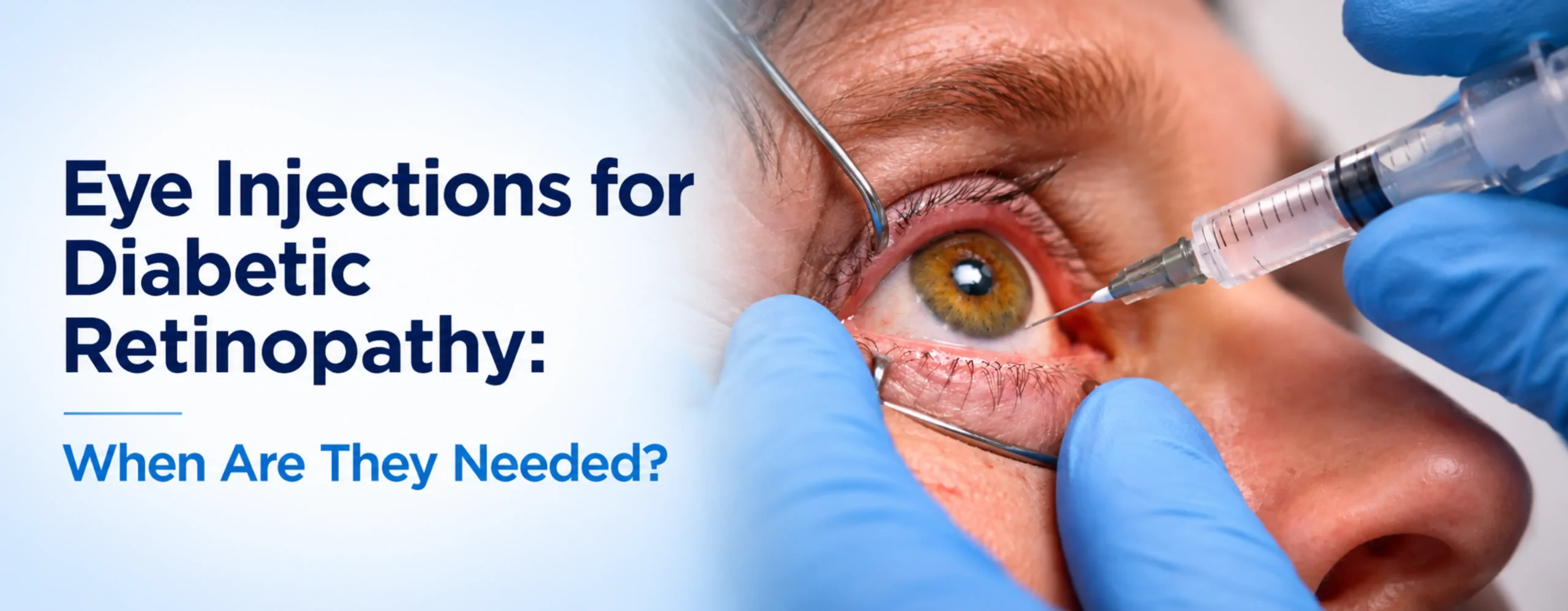
The eye is numbed with anaesthetic drops first, and the injection itself takes a few seconds.
Patients may notice:
- Brief pressure during the injection
- Mild grittiness or irritation for a day
- A small red spot on the white of the eye, which is harmless and fades on its own
- Floating spots or a small bubble in the vision for a day or two
What Are the Other Common Eye Conditions Treated With Eye Injections?
An eye injection is also used to treat:
- Wet age-related macular degeneration
- Macular oedema from retinal vein occlusion.
- Abnormal vessels under the retina in high myopia
- Retinopathy of prematurity, in selected premature babies
- Macular swelling caused by uveitis, using steroid injections
- Infection inside the eye (endophthalmitis), using antibiotic injections
Also Read: Understanding Macular Degeneration and Its Impact on Vision
What Happens During an Eye Injection?
Before the injection
- A vision test and OCT/FFA/Colour photo etc scan to measure the macular swelling
- Numbing drops and an antiseptic solution to clean the eye and eyelids
During the injection
- A small clip holds the eyelids open
- The medicine is injected through the white of the eye in a few seconds
After the injection
- Eye pressure may be checked before you leave
- Most patients go home the same day; avoid rubbing the eye
How often are injections needed?
There is no fixed number of injections that works for every patient.
For diabetic macular oedema, treatment commonly begins with relatively frequent injections, often around four weeks apart.
The interval may then be adjusted according to:
- Visual acuity
- OCT findings
- Amount of residual macular swelling
- Recurrence of fluid
- Response to previous injections
- Type of medicine used
The eye injection price for an individual patient can only be estimated after the examination.
Will I Need Eye Injections for Life?
Not necessarily.
Some patients achieve sustained control and can stop injections under specialist supervision.
Others experience recurrent swelling or abnormal vessel activity and require further treatment.
When Should You Consult a Retina Specialist?
Immediately, if you notice:
- Sudden floaters or a dark haze in the vision
- A sudden drop in vision
- A dark curtain or shadow across part of the vision
- Pain, redness or worsening vision after an injection
Timely retinal check if:
- You have diabetes, even with normal vision
- Vision is gradually blurred or distorted
- Reading or recognising faces has become harder
- Blood sugar, blood pressure or cholesterol are poorly controlled
My Vision Is Fine. Can I Delay My Retinal Injection?
Do not delay a scheduled retinal injection without consulting your retina specialist. Vision may feel stable even when OCT shows persistent or recurrent swelling. In proliferative diabetic retinopathy, abnormal new blood vessels can also remain active without obvious symptoms. Your specialist may safely extend intervals, change treatment or recommend observation when the retinal findings support it.
Why Is a Timely Follow-Up Eye Checkup Important?
Injections control diabetic eye disease. They do not cure it. Swelling can return, and abnormal vessels can regrow, when injections are delayed.
A 2019 study in Ophthalmology followed 76 eyes with proliferative diabetic retinopathy whose patients missed follow-up for more than six months after treatment:
- 10 of 30 eyes treated with anti-VEGF injections developed retinal detachment
- 1 of 46 eyes treated with laser did
The study was small and not randomised, but it shows how closely injection treatment depends on regular visits.
Each follow-up also checks the other eye and confirms whether the gap between injections can be extended.
Diabetic Retinopathy Care at AKIO: Retina Specialist in Delhi
Medical Director and Padma Shri awardee Dr Atul Kumar leads AKIO’s retina team, with 41+ years of retinal expertise and experience as former Chief of the Dr Rajendra Prasad Centre for Ophthalmic Sciences, AIIMS, New Delhi.
Dr Aman Kumar, Senior Consultant Vitreo-Retinal and Cataract Surgeon, is an AIIMS New Delhi alumnus and PGIMER Chandigarh Gold Medallist whose work includes diabetic retinopathy, macular disorders and retinal surgery.
AKIO provides diabetic retinopathy management from screening to surgery: OCT, FFA or OCTA and widefield retinal imaging, intravitreal injections, laser photocoagulation and vitrectomy. For patients looking for a retina specialist in Delhi for eye injections, the first step is a dilated retinal examination and OCT scan to confirm whether injections are needed at all.
About the Author: Dr Aman Kumar
Dr Aman Kumar is a Senior Consultant Vitreo-Retinal and Cataract Surgeon at AK Institute of Ophthalmology (AKIO), New Delhi. He is an alumnus of AIIMS New Delhi and a Gold Medallist from PGIMER Chandigarh, where he completed his MS and then did his senior residency at the Dr Rajendra Prasad Centre for Ophthalmic Sciences, AIIMS. His clinical work covers complex retinal conditions, including retinal detachment, diabetic retinopathy, macular disorders, and uveitis. He performs 3D vitreoretinal surgery and micro-incision cataract surgery.
Frequently Asked Questions
Are eye injections painful?
Most patients feel brief pressure, not pain, because the eye is numbed first. Mild grittiness for a day afterwards is common.
What are the potential side effects of eye injections for diabetic retinopathy?
A red spot on the eye, grittiness and floaters for a day or two are common. Serious infection is rare, at about 1 in 2,000 injections.
Can an anti-VEGF injection restore normal vision?
Not always. Injections often improve vision and prevent further loss, but long-standing swelling or poor blood flow can limit recovery.
Is one injection enough for retina treatment?
Rarely. Most patients need a series of injections, usually monthly at first, then spaced out as the swelling settles.
Are injections the only option?
No. Laser, steroid implants and vitrectomy are also used, and control of blood sugar, blood pressure and cholesterol remains essential.
What is the eye injection price at AKIO?
It depends on the medicine, the number of injections and the scans needed. Book a consultation at AKIO for an exact estimate.
Will I need eye injections for the rest of my life?
Not necessarily. Some patients can stop injections after sustained disease control, while others require ongoing or intermittent treatment.


Recent Posts
- Eye Bleeding: Could Sudden Floaters or Blurry Vision Be a Sign of Retinal Bleeding?
- Eye Injections for Diabetic Retinopathy: When Are They Needed?
- Retinal Vein Occlusion: Who Is at Risk and How Is It Treated?
- How to Choose the Right IOL for Cataract Surgery: A Patient’s Guide
- Can A Retinal Tear Heal On Its Own? When Is Retinal Laser Needed?