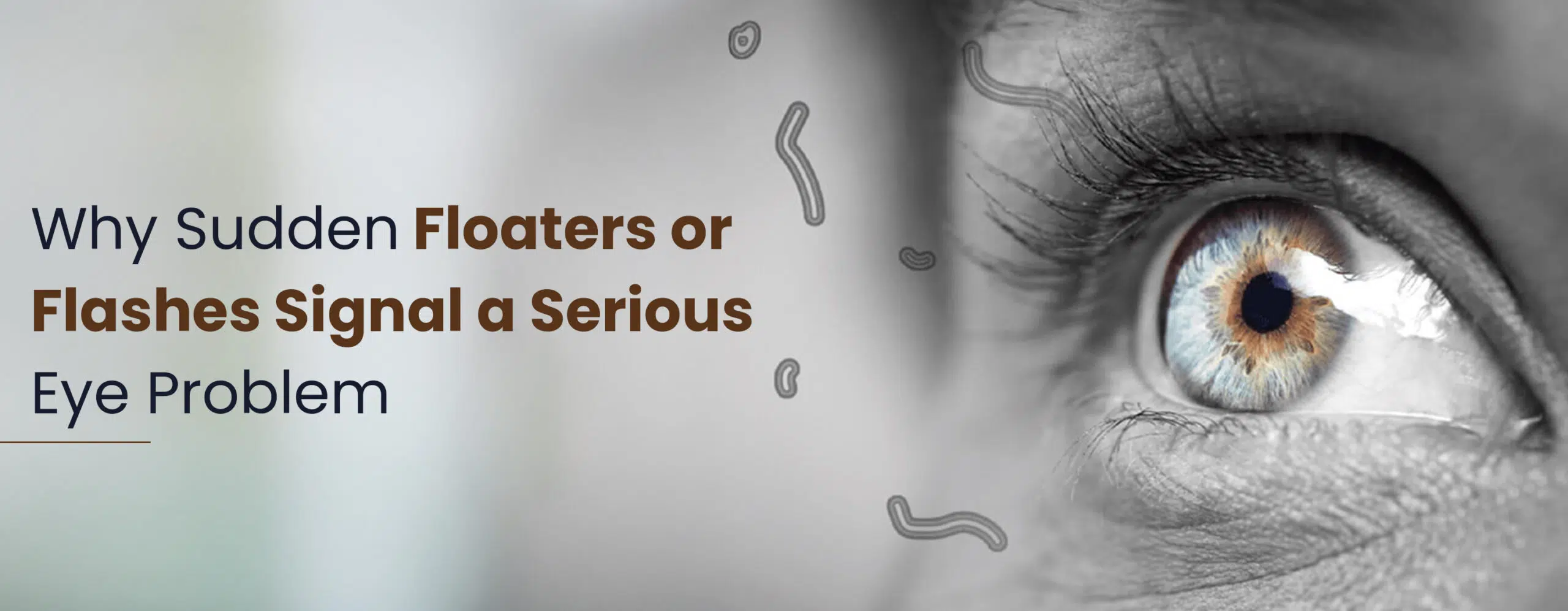
You are reading a book, or perhaps looking at a clear blue sky, and you see it. A faint, grey speck drifting slowly across your vision. You blink to wipe it away, but it moves with you, darting off just as you try to focus on it.
For most of us, these small “cobwebs” are a normal part of ageing. We learn to ignore them.
However, there is a critical difference between the drifting specks you have lived with for years and a sudden change in your vision. When eye floaters and flashes appear unexpectedly, it is not just a nuisance; it is a direct message from your eye that something fundamental is shifting inside.
What Is Actually Happening Inside Your Eye?
To understand the risk, you need to understand the anatomy. The main chamber of your eye is filled with a clear, jelly-like substance called the vitreous humour. In a young eye, this gel is firm and fills the space perfectly, keeping the retina flat against the back wall.
But as we age, the texture of this gel changes. It begins to liquefy and shrink, a natural process known as syneresis. As the vitreous shrinks, microscopic collagen fibres clump together. These tiny clumps cast shadows onto your retina.
Those shadows are the floaters you see.
the vitreous gel pulls away from the back of the eye abruptly. This is called a Posterior Vitreous Detachment (PVD). If the gel adheres too tightly to the retina as it pulls away, it can tug on the delicate tissue. If that tug turns into a tear, you are facing a serious problem.
When does it become an Eye Emergency?
We advise all our patients to be vigilant without being paranoid. You do not need to worry about every single speck. However, there are 3 specific symptoms that classify as a potential Eye emergency.
If you experience these, we urge you to visit a specialist immediately.
1. The “Pepper” Shower
If you notice a sudden burst of tiny black spots, many patients describe it as looking like pepper has been shaken into their vision or seeing “smoke”; this is significant.
Sudden Flashes of Light
You might see a quick white arc of light in your peripheral vision, similar to a camera flash or a lightning bolt.
The Grey Curtain
This is the most critical sign. If you perceive a dark shadow or a grey “veil” moving in from the side, top, or bottom of your vision, it suggests the retina has already detached. Immediate intervention is required to prevent permanent vision loss.
How to Reduce Eye Floaters: Fact vs. Fiction
We frequently encounter patients asking how to reduce eye floaters through diet, eye drops, or exercises.
There is currently no scientifically proven natural method to physically dissolve floaters. They are debris floating within a closed system. No amount of “eye yoga” or vitamins can remove them.
However, there is reassurance. In the vast majority of cases, the brain is incredibly adaptive.
Led by Dr Atul Kumar (Padma Shri Awardee), our team has decades of experience in managing complex retinal conditions. We utilise state-of-the-art 3D visualisation technology, allowing our Retina Specialist in Delhi to view the vitreous and retina in high-definition depth. This ensures that any diagnosis is accurate and any treatment is delivered with micron-level precision.
Short Summary
Your vision is resilient, yet the retina remains delicate. If you have had the same few floaters for years, there is likely no cause for alarm. But if the pattern changes, if you see new lights, new dots, or shadows, please do not wait. It is always better to have an exam and be told everything is fine than to wait and risk your sight. We are here to help you navigate these changes with confidence and care.
Final Words
A retinal detachment is the ocular equivalent of a heart attack, silent, sudden, and time-sensitive. The difference between blindness and sight often comes down to how quickly you react to that first “flash” or “shadow.” Never wait to “see if it gets better.” If your vision suddenly falls, head to a specialised eye hospital like AKIO immediately.