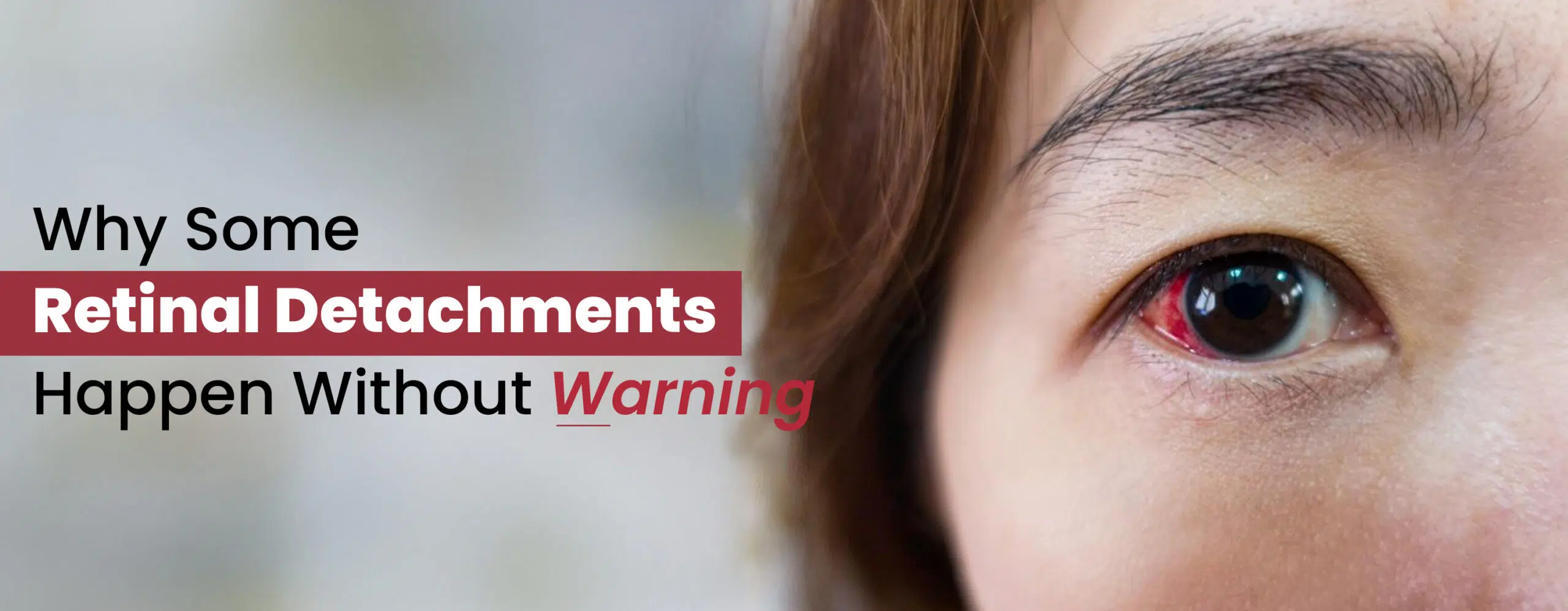
We are biologically programmed to associate injury with pain. If a bone breaks, it throbs. If the cornea is scratched, it stings. But the retina plays by a different set of rules.
The retina is neurosensory tissue, essentially an extension of the brain, but it doesn’t have any pain receptors. You can tear it, pull it, or peel it entirely off the back of the eye, and you will not feel a single sensation of physical discomfort. This is the dangerous paradox of retinal detachment.
Can a Retina Detachment Happen Without Warning?
If the retina cannot feel pain, how does it detach?
This is often driven by Posterior Vitreous Detachment (PVD). The eye is filled with a clear gel called the vitreous. As we age, this gel liquefies and shrinks, slowly pulling away from the retina. Usually, it separates cleanly.
It doesn’t rip suddenly; it tugs gently, day after day. Eventually, a tiny hole opens. Fluid seeps through this gap, settling behind the retina and peeling it off the wall like a sticker losing its grip. Because this happens slowly and often in the peripheral vision.
Other major retinal detachment causes include High Myopia (Nearsightedness). Elongated eyeballs stretch the retina thin, creating weak patches known as “lattice degeneration” that can give way spontaneously, often without a single flash of light to warn you.
Warning Signs of Retinal Detachment
Just because there is no pain does not mean there are no signals. The eyes often provide subtle Warning Signs of Retinal Detachment that many patients mistakenly ignore –
The “Pepper” Shower A sudden appearance of tiny black dots (unlike your usual floaters)
The Peripheral Smudge Patients often describe a sensation of a “dirty lens” or a shadow in the corner of their eye that they cannot blink away.
The Arc of Light While not always present, a quick, white arc of light in your side vision (visible best in the dark) is the retina physically tugging against the eye wall.
Ignoring these warning signs of retinal detachment is very dangerous to your sight.
Top Retina Specialist in Delhi
For patients in the capital, the AK Institute of Ophthalmology (AKIO) is the renowned best retina hospital in Delhi for advanced retinal care.
Dr Atul Kumar (Padma Shri Awardee) A pioneer in the field, Dr Kumar is widely regarded as a top retina specialist in Delhi. With over four decades of experience, he specialises in salvage protocols for complex cases.
Dr Aman Kumar Representing the next generation of surgical precision, Dr Aman utilises 3D visualisation systems for Micro-Incision Vitrectomy Surgery (MIVS). This technology allows for greater depth perception during surgery, ensuring that even silent, chronic detachments are repaired with minimal tissue disruption.
Conclusion
The absence of symptoms is not a guarantee of health. It is not certain that retinal detachment will always give us a warning bell. The only failsafe against a silent detachment is a proactive, dilated retinal exam, especially if you are over 50 or highly nearsighted. Don’t wait for the lights to go out. If you notice a shadow, a new floater, or a persistent blur, treat it as an eye emergency.