

 Posted By Akio
- Comments 0

Retinal detachment is a medical emergency that can lead to permanent vision loss if not treated promptly. Early diagnosis and timely retinal surgery often provide the best chance of preserving sight.
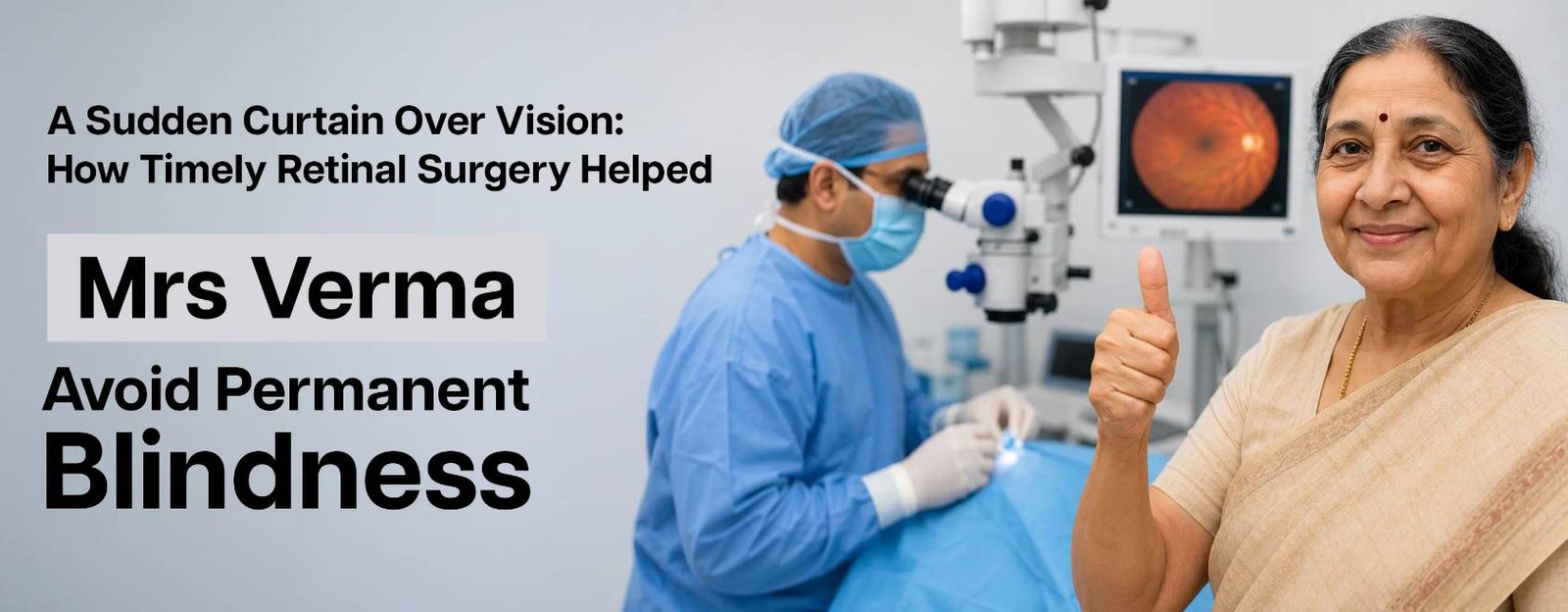
This is the story of how a 54-year-old Delhi resident, Mrs Kavita Verma, recognised a warning sign which was a dark shadow-like sensation over her vision. She sought specialist care at AK Institute of Ophthalmology and successfully regained her vision.
She blinked. It’s there, and nothing has changed in her vision.
The First Reaction, and the One That Saved Her Vision
Her first thought was tiredness. Too much screen time, maybe. Or maybe due to morning lights.
By evening, though, nearly half of her left eye’s vision was gone.
She blinked several times.
The shadow remained.
Fortunately, her family encouraged her to seek immediate medical care and visit for a consultation with Dr Aman Kumar.
That decision ultimately saved her eyesight.
That decision saved her vision.
Can a Dark Curtain Over Vision Be a Sign of Retinal Detachment?
Yes, Many patients describe retinal detachment as:
- A curtain moving across vision
- A shadow spreading from one side
- Missing areas of vision
- A dark patch that gradually enlarges
Unlike many eye conditions, retinal detachment is usually painless.
This makes it easy to dismiss early symptoms until significant vision loss has already occurred.
Read More: Retinal Detachment
What Was Actually Happening Inside Her Eye?
Mrs Verma was experiencing a retinal detachment.
The retina is a thin, light-sensitive layer located at the back of the eye.
It functions much like a camera.
When the retina detaches from the tissue beneath it:
- Blood supply becomes compromised
- Retinal cells begin to suffer damage
- Vision gradually disappears
Without treatment, permanent blindness can occur.
The longer the retina remains detached, the lower the likelihood of full visual recovery.
Why Early Diagnosis Matters in Retinal Detachment
One of the most important factors affecting retinal detachment outcomes is timing.
When treatment occurs early:
- More retinal tissue can be preserved
- The macula may remain attached
- Visual recovery is often significantly better
When treatment is delayed:
- Central vision may become permanently affected
- Surgery becomes more complex
- Recovery may be limited
This is why retinal detachment is considered a true eye emergency.
How Mrs Verma Was Diagnosed at AKIO
A comprehensive retinal examination was performed.
Advanced Diagnostic Evaluation Included:
- Dilated retinal examination
- Retinal imaging
- Macular assessment
- Peripheral retinal evaluation
The examination confirmed a significant retinal detachment in the left eye.
Immediate surgery was advised.
The Retinal Surgery That Helped Save Her Vision
Because the condition was diagnosed early, surgery was scheduled without delay.
The procedure was performed by Dr Aman Kumar, an experienced vitreoretinal surgeon having experience of prestigious institutions like AIIMS New Delhi & PGI Chandigarh.
Surgical Goals
- Relieve traction on the retina
- Reattach detached retinal tissue
- Seal retinal breaks
- Preserve central vision
Using advanced 3D retinal surgical technology, the retina was successfully reattached.
Retina Surgery Recovery: What Patients Should Expect
Following retinal detachment surgery, recovery is gradual.
Mrs Verma was advised to:
Maintain Specific Head Positioning
This helps support retinal healing.
Use Prescribed Eye Drops
To reduce inflammation and prevent infection.
Attend Follow-Up Visits
To ensure the retina remains attached.
Like many retinal surgery patients, vision improved gradually over several weeks.
The Outcome
At follow-up visits:
- The retina remained fully attached
- No recurrent detachment occurred
- No major complications were observed
Mrs Verma recovered near-normal functional vision and returned to her daily routine.
Her experience highlights the importance of recognising symptoms early and seeking expert care without delay.
“I still don’t have words for the moment, my vision is back. I cried when I could see my daughter’s face clearly again.”
– Mrs Kavita Verma
Who is at Higher Risk of Retinal Detachment?
You may have an increased risk if you:
- Have high myopia (high minus power)
- Have diabetes
- Have undergone cataract surgery
- Have suffered previous eye trauma
- Have a family history of retinal detachment
- Previously had retinal tears or retinal surgery
Regular retinal examinations are particularly important for these individuals.
Also Read: From Flashes to Vision Recovery: How Early Retinal Detachment Surgery Helped Mr Gupta Save His Sight
Why Patients Choose AKIO for Retinal Emergencies
At AKIO, retinal emergencies are evaluated and treated using advanced diagnostic and surgical technology.
1. Retina Experts
Dr Aman Kumar
AIIMS alumnus
PGIMER Gold Medalist
Specialist in retinal detachment surgery
Expertise in advanced 3D retinal procedures
Dr Atul Kumar
Padma Shri Awardee
Former Chief, Dr RP Centre, AIIMS
More than 40 years of vitreoretinal surgical experience
2. Technology
Advanced OCT imaging
Widefield retinal diagnostics
3D retinal surgery systems
Micro-incision vitreoretinal surgery
Consult Dr Aman Kumar – Best Retina Surgeon in Delhi
Dr Aman Kumar is a Senior Consultant Vitreo-Retinal Surgeon at AK Institute of Ophthalmology (AKIO), Safdarjung Enclave, New Delhi. An AIIMS alumnus, Gold Medallist from PGIMER Chandigarh, and recipient of the Best Free Paper Award at the American Academy of Ophthalmology, he is widely regarded as the best retina and cataract surgeon in Delhi for both emergency and elective retinal cases.
At AKIO, he works alongside Padma Shri Dr Atul Kumar, with cutting-edge 3D surgical technology, and same-day emergency appointments available when every hour counts.
Summary
Mrs Verma’s outcome was not a matter of luck.
It was the result of recognising a warning sign, seeking prompt specialist care and undergoing timely retinal surgery for the experts.
If you experience a sudden shadow, curtain over vision, flashes, floaters, or unexplained vision loss, consult a retina specialist immediately.
When it comes to retinal detachment, every hour matters.
Frequently Asked Questions
What does retinal detachment look like?
Many patients describe it as a dark curtain, shadow, or missing section of vision.
Can retinal detachment heal without surgery?
No. Retinal detachment requires urgent medical treatment and often surgery.
How quickly should retinal detachment be treated?
Ideally, as soon as possible. Earlier treatment generally results in better visual outcomes.
Is retinal detachment painful?
No. Most retinal detachments occur without pain.
Can vision return after retinal detachment surgery?
Many patients experience significant visual recovery, especially when surgery is performed early.


Recent Posts
- How to Choose the Right IOL for Cataract Surgery: A Patient’s Guide
- Can A Retinal Tear Heal On Its Own? When Is Retinal Laser Needed?
- Macular Hole: Why Straight Lines Look Bent, or Faces Look Distorted
- Can Retinal Detachment Cause Permanent Blindness? How Fast Should You Get Treatment?
- Eye Floaters – When Are They Normal And When Could They Be A Sign of Retinal Detachment?