

 Posted By Akio
- Comments 0

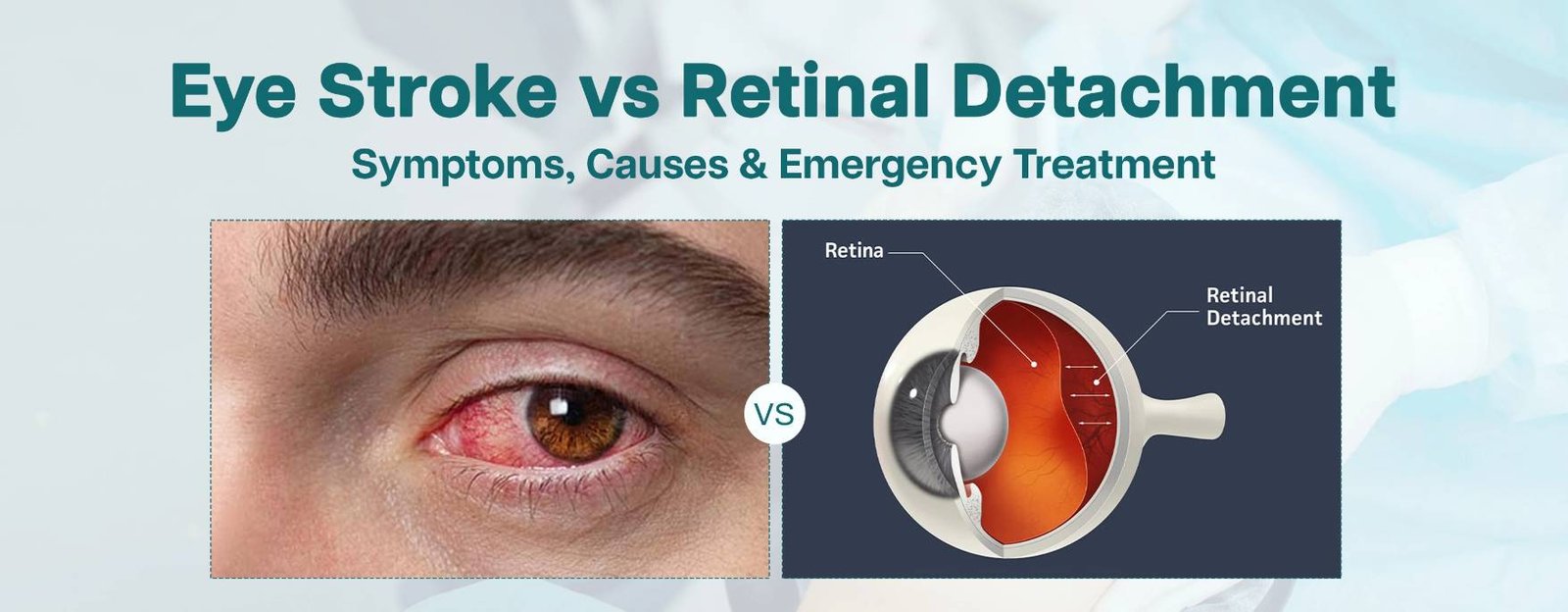
An eye stroke and a retinal detachment are both serious emergencies that can cause sudden vision loss, but they occur for completely different reasons.
An eye stroke happens when blood flow to the retina is blocked, depriving retinal tissue of oxygen.
A retinal detachment occurs when the retina physically separates from the back wall of the eye, cutting off its nutrient supply.
Both conditions require urgent evaluation by a retina specialist because delayed treatment can result in permanent vision loss
How Can You Tell Whether Sudden Vision Loss Is an Eye Stroke or Retinal Detachment?
The symptoms often overlap, which is why self-diagnosis is dangerous.
However, there are some important differences.
Eye Stroke Usually Causes:
- Sudden painless vision loss
- Grey, dim, or washed-out vision
- Partial or complete blackout in one eye
- Vision loss occurring within minutes
- Often associated with heart disease, diabetes, or high blood pressure
Retinal Detachment Usually Causes:
- Sudden flashes of light
- New floaters appearing suddenly
- Dark shadow or curtain moving across vision
- Progressive worsening over hours or days
- Distorted or blurred vision
If you experience any of these symptoms, seek emergency retinal evaluation immediately.
What is an Eye Stroke?
An eye stroke, medically called Central Retinal Artery Occlusion (CRAO), occurs when blood flow to the retina suddenly stops.
The retina requires a constant oxygen supply to function.
Many eye stroke patients also have underlying cardiovascular disease.
Note: The 2024 American Academy of Ophthalmology guidelines now recommend treatment within 4.5 hours of symptom onset for the best chance of vision recovery.
Risk Factors of Eye Stroke
- High blood pressure (hypertension)
- Diabetes
- High cholesterol
- Smoking
- Carotid artery disease
- Heart rhythm abnormalities
- Previous stroke or TIA
- Age above 60 years
What is Retinal Detachment?
Retinal detachment occurs when the retina separates from the inner wall of the eye.
Without immediate treatment, retinal cells lose access to oxygen and nutrients.
Over time:
- Vision deteriorates
- Central vision becomes affected
- Permanent blindness can occur
Unlike an eye stroke, retinal detachment is primarily a mechanical problem rather than a vascular problem.
A South India-based clinical study published in The British Journal of Ophthalmology found that the macula was already detached in 86.8% of patients who arrived late for treatment, highlighting just how quickly this condition can escalate.
Also Read: From Flashes to Vision Recovery: How Early Retinal Detachment Surgery Helped Mr Gupta Save His Sight
Retinal Detachment Symptoms and Signs
- A sudden shower of new floaters, small dark spots, threads, or cobweb-like shapes
- A dark shadow or curtain
- Blurred or distorted vision
- No significant pain in most cases
Risk Factors of Retinal Detachment
- High myopia (short-sightedness)
- Previous eye surgery
- Eye trauma
- Family history of retinal detachment
- Lattice degeneration
- Prior retinal detachment in the other eye
What are the key Differences Between an Eye Stroke and a Retinal Detachment?
Feature | Eye Stroke | Retinal Detachment |
Underlying cause | Blocked blood vessel (clot or plaque) | Retina separates from the eye wall |
Cause | loss of blood flow to the retina | tear, fluid, or traction |
Primary symptom | Suddenly, complete vision loss in one eye | Floaters, flashes, then shadow/curtain |
Onset pattern | Suddenly, within seconds to minutes | Often starts with floaters, worsens over hours |
Pain | Painless | Painless |
Associated systemic risk | Strongly linked to heart disease and stroke risk | Linked to myopia, eye surgery, and diabetes |
Vision loss pattern | Entire Vision Immediately | Affects central Vision |
Diagnosis tool | photography, OCT, fluorescein angiography | Ultrasound B-scan, OCT, indirect ophthalmoscopy |
Treatment urgency | Within 4.5 hours | Within 24-48 hours ideally |
Treatment type | Cardiovascular workup + ocular management | Laser, vitrectomy, scleral buckle |
Which Condition Is More Dangerous?
Both are sight-threatening emergencies.
An eye stroke requires immediate restoration of blood flow and urgent cardiovascular assessment.
A retinal detachment requires prompt retinal repair to prevent permanent vision loss.
In both situations, early diagnosis significantly improves outcomes.
Best Retina Specialist in Delhi – Advanced Retina Care at AKIO
At AKIO (AK Institute of Ophthalmology), the best retina hospital in Delhi, we help our patients with retinal emergencies with the speed and precision it deserves.
Our team of expert retina specialists combines some of the country’s most experienced surgical hands with technology that allows us to act accurately.
- Dr. Atul Kumar
Padma Shri Awardee and former Chief of the prestigious Dr R.P. Centre at AIIMS, known as the best retina surgeon in Delhi, brings over 41 years of retina expertise and an unmatched depth of surgical experience to every complex case, including advanced vascular occlusions and difficult detachments that have been referred from other centres.
- Dr. Aman Kumar
AIIMS alumnus and PGIMER Gold Medalist, known as the best retina and cataract surgeon in Delhi, specialises in advanced retinal diagnosis and 3D retinal surgery, with particular strength in managing diabetic tractional detachments, complex vitreoretinal procedures, and post-traumatic retinal injuries.
Advanced Diagnostic Technology
OCT Retinal Imaging
Fluorescein Angiography
Widefield Retina Imaging
Ultrasound B-Scan
Retinal Vascular Evaluation
Retinal Treatment Available at AKIO
- Laser photocoagulation for early retinal tears before detachment occurs
- 3D Micro-incision vitrectomy (MIVS) for complete retinal detachment
- Diabetic retina management programme.
Both conditions, eye stroke and retinal detachment, are treated as priority emergencies
Key Takeaway
The biggest difference between an eye stroke and retinal detachment is the underlying cause.
- An eye stroke occurs because blood flow to the retina is blocked.
- A retinal detachment occurs because the retina physically separates from the eye wall.
Both conditions can lead to permanent blindness if ignored.
If you notice sudden vision changes, immediate evaluation by a retina specialist offers the best chance of protecting your sight. Do not wait for it to resolve on its own.
Reach out to the expert retina team at AKIO immediately.
Frequently Asked Questions
Can an eye stroke be reversed?
Vision recovery depends on how quickly treatment begins. Early intervention offers the best chance of preserving vision.
Are flashes and floaters always a sign of retinal detachment?
Not always. However, sudden onset flashes and floaters should always be examined urgently by a retina specialist.
Is retinal detachment painful?
No. Most retinal detachments occur without pain, redness, or discomfort.
Can diabetes increase the risk of both conditions?
Yes. Diabetes is a significant risk factor for both retinal vascular disease and retinal detachment.
Which symptoms require emergency attention?
Sudden vision loss, flashes of light, new floaters, dark shadows, or a curtain over vision should always be treated as an emergency.


Recent Posts
- How to Choose the Right IOL for Cataract Surgery: A Patient’s Guide
- Can A Retinal Tear Heal On Its Own? When Is Retinal Laser Needed?
- Macular Hole: Why Straight Lines Look Bent, or Faces Look Distorted
- Can Retinal Detachment Cause Permanent Blindness? How Fast Should You Get Treatment?
- Eye Floaters – When Are They Normal And When Could They Be A Sign of Retinal Detachment?