

 Posted By Akio
- Comments 0

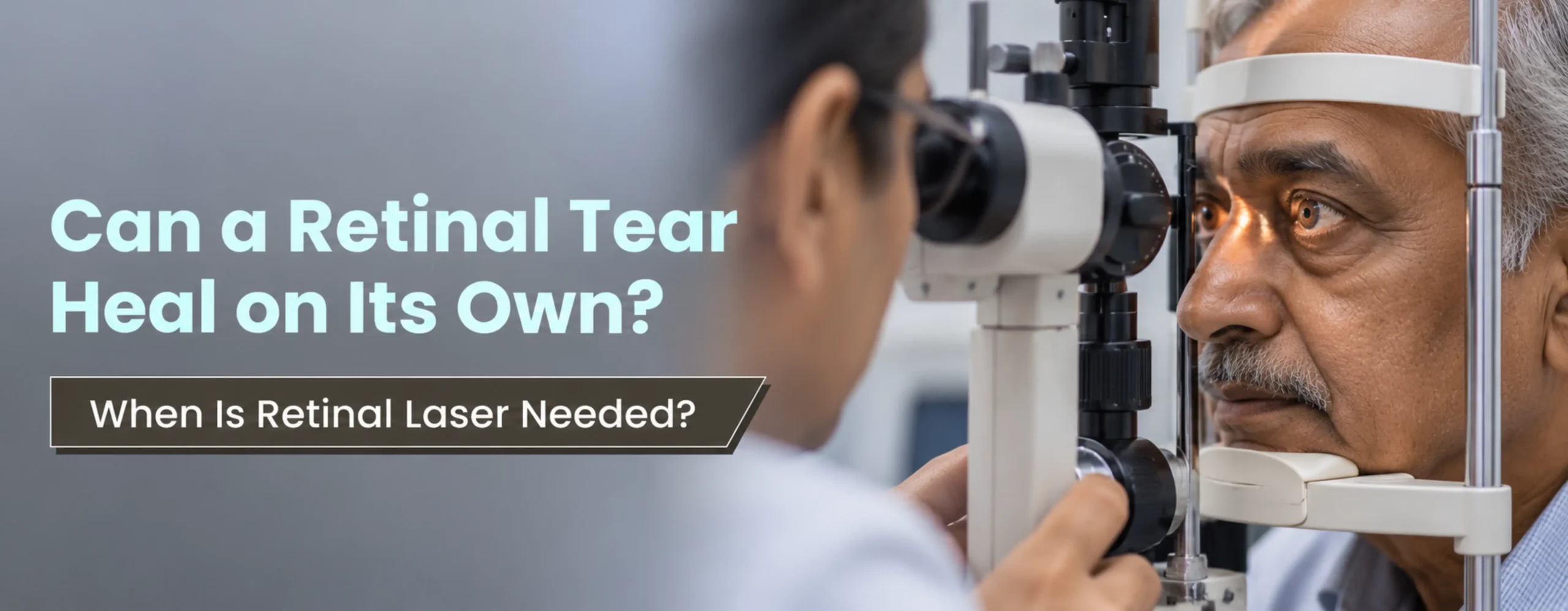
Can a Retinal Tear Heal on Its Own?
Some small, asymptomatic retinal holes or low-risk retinal breaks discovered incidentally may remain stable without treatment. In these cases, a retina specialist may recommend observation with periodic retinal examinations rather than immediate laser.
Once a tear is causing symptoms, most do not heal on their own, and an untreated tear carries a real risk of progressing to retinal detachment, a far more serious condition.
That risk is why any new or worsening symptom needs immediate retinal evaluation rather than a wait-and-watch approach at home.
A retina specialist can then determine whether observation, laser, or another treatment is appropriate.
What Is Retina Laser Treatment?
Retinal laser treatment, or laser retinopexy, uses a focused beam of light to create a ring of small burns around a retinal tear. Each burn forms a scar that fuses the retina to the tissue beneath it, treating the edges of the tear so fluid cannot pass through and lift the retina away from the eye wall. It is performed without any incision.
The laser does not remove the retinal tear. It creates a protective seal around it.
What Are the Retinal Tear Symptoms?
- A sudden shower of new floaters
- A sudden increase in existing floaters
- New black dots, specks, or cobweb-like strands
- Flashes of light, particularly at the edge of vision
- Blurred vision in the affected eye
- Some Retinal tears cause no symptoms at all and are found only on a dilated eye examination
- A curtain or shadow spreading across part of the vision is a more advanced warning sign and suggests the tear may already be progressing toward detachment
Also Read: Can A Retinal Tear Cause A Headache Behind The Left Eye? Dr Aman Kumar Explains The Symptoms
When Is Retina Hole Laser Treatment Needed?
- The tear is causing symptoms, such as new flashes or floaters
- The tear is a type associated with a higher detachment risk, including a horseshoe-shaped tear with ongoing vitreous traction
- The fellow eye has a history of retinal tear or detachment
- The tear sits near an area of lattice degeneration or in a highly myopic eye
- A small, asymptomatic tear found incidentally may instead be monitored with regular examinations rather than treated immediately, depending on its size, location, and risk profile
How Is Retina Laser Treatment Performed?
Pre-procedure
- Dilating drops to widen the pupil
- Numbing (anaesthetic) drops so the procedure is not painful
- A detailed fundus examination
- OCT or additional retinal imaging when needed to plan treatment
Procedure
- The patient sits at a slit-lamp-mounted laser, with a contact lens placed on the eye after numbing drops
- The surgeon applies a ring of laser burns around the tear
- Most patients notice brief flashes of light and a mild warmth or pricking sensation rather than pain
- The procedure typically takes 5 to 7 minutes and is done the same day, without hospital admission
Types of laser
- Laser photocoagulation (commonly argon or green laser) is the standard treatment for most retinal tears and is done directly through the pupil
- Cryotherapy (a freezing probe applied from outside the eye) is used instead when the tear sits very far in the periphery, or when blood or haze in the eye makes it hard to get a clear laser view of the tear
- Both create the same outcome, a scar that welds the retina down around the tear, and the choice between them depends on the tear’s location and how clearly it can be visualised
Recovery After Retina Laser?
Immediate
- A gritty or mildly irritated feeling in the treated eye
- Temporarily blurred vision from the dilating drops, which usually settles within a few hours. Most patients resume light, everyday activities
- Prescribed drops are used as directed
Follow-Up Examination
Follow-up is an important part of retinal tear treatment.
The retina specialist checks whether:
- The tear is adequately surrounded by laser
- The laser reaction is satisfactory
- Additional laser is required
- New retinal tears have appeared
The timing of follow-up depends on the tear and the patient’s individual retinal risk.
When to See a Retina Surgeon
Immediately, if you notice:
- A sudden increase in eye floaters
- New flashes of light
- A curtain or shadow spreading across your field of vision
- A sudden drop in vision in one eye
Timely routine check for:
- High myopia
- A family history of retinal tear or detachment
- A previous tear or detachment in either eye
- Recent eye injury or intraocular surgery
Retinal Tear Laser Surgery at AK Institute of Ophthalmology (AKIO)
AKIO’s retina team in Delhi, led by Dr. Atul Kumar, Padma Shri Awardee and former Chief of the Dr RP Centre at AIIMS, with over four decades of retina experience.
Dr. Aman Kumar is a Senior Consultant Vitreo-Retinal and Cataract Surgeon at AKIO, New Delhi. An AIIMS alumnus and PGIMER Gold Medallist, he specializes in complex retinal conditions, retinal surgery, diabetic retinopathy, macular disorders, uvea, and advanced cataract surgery.
For patients looking for a retina specialist in Delhi for retinal tear laser treatment, the most important first step is a detailed peripheral retinal examination to determine whether the break requires treatment or can safely be monitored.
Frequently Asked Questions
Is it too late for laser eye surgery with people above the age of 70?
No. Age on its own is not a barrier to retinal laser treatment, and many patients in their 70s and 80s are treated safely.
How long does it take to recover from retinal tear laser surgery?
Most everyday comfort returns within a day.
Can a patient start walking an hour the day after retinal tear laser surgery?
Generally, yes. Laser retinopexy does not involve an incision or a gas bubble, so walking is usually fine.
What should you avoid doing after retinal laser surgery?
Avoid rubbing or pressing the treated eye, strenuous exercise, heavy lifting, and swimming until your surgeon confirms it is safe.
Are there any side effects of retinal laser?
Most are mild and temporary, with a gritty sensation, glare, and blurred vision in the first day or so.
Can Retinal Detachment Still Happen After Laser?
Yes, laser reduces the risk of retinal detachment but cannot prevent all future retinal problems. New tears or retinal changes can occasionally develop.
Can Retinal Laser Affect Vision?
Temporary blurring or mild visual changes may occur after retinal laser treatment. The effect depends on the location and severity of the retinal condition being treated.
Can I Travel After Retinal Tear Laser?
Travel may be possible after retinal tear laser once your ophthalmologist confirms that the retina is stable. Follow-up care is important, especially if you notice new flashes, floaters, or a shadow in your vision.


Recent Posts
- How to Choose the Right IOL for Cataract Surgery: A Patient’s Guide
- Can A Retinal Tear Heal On Its Own? When Is Retinal Laser Needed?
- Macular Hole: Why Straight Lines Look Bent, or Faces Look Distorted
- Can Retinal Detachment Cause Permanent Blindness? How Fast Should You Get Treatment?
- Eye Floaters – When Are They Normal And When Could They Be A Sign of Retinal Detachment?